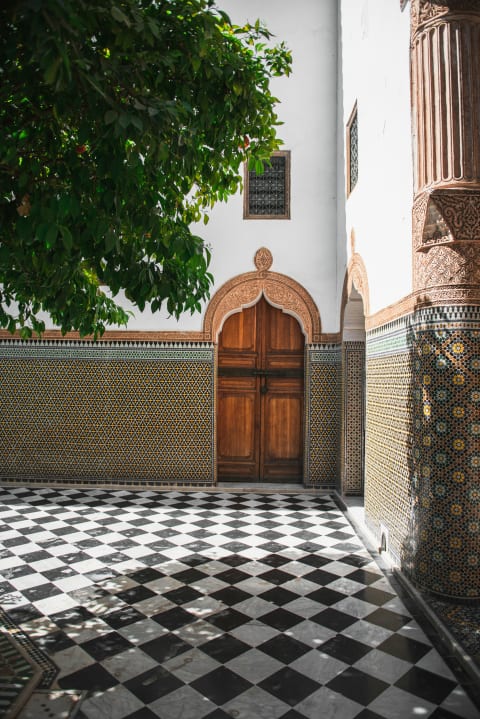
The zawiya sits at the corner of the medina where two streets meet, unmarked except for a green-painted door. You would walk past it without a second thought. Behind the door is a school, a soup kitchen, a shrine, and four centuries of accumulated prayer. The door is green because green is the colour of the Prophet. The door is unmarked because the people who need it already know where it is.
In Arabic, zawiya means "corner." In Morocco, it became something larger: a monastery, a school, a political power centre, and a saint's tomb compressed into one walled compound. The architecture is modest. The influence was not.
Sufism arrived in Morocco with Islam itself but flowered after 1492, when the Reconquista expelled Muslims from Iberia and Sufi orders migrated south, carrying their practices and their organisational genius. The Tijaniyya, founded in Fes in the 1780s, today claims hundreds of millions of adherents worldwide, which makes it one of the largest spiritual movements on earth and one of the least known outside the Islamic world.
The zawiyas were not merely spiritual. They were banks — storing grain for famine years. They were hotels — sheltering travellers and pilgrims. They were schools — teaching theology, grammar, and the particular Moroccan talent for combining religion with pragmatism. Most dangerously, they were political. The Dila Zawiya controlled central Morocco in the 17th century until Moulay Rashid burned it in 1668, which is the standard response of a sultan who has noticed that a religious institution has started behaving like a government.
The sacred geography remains. Moulay Idriss, great-grandson of the Prophet, founded the Idrisid dynasty in 789. His tomb near Volubilis is Morocco's most sacred pilgrimage — the place where the country's spiritual history and its political history meet at the same grave. The green door is still there. The soup kitchen still serves. The prayer still rises. The corner still holds.
The zawiyas are still there at the corners where two streets meet. Green doors, unmarked, holding the medina together.
Tell us about your trip →The Facts
- —Zawiya = "corner" in Arabic
- —In Morocco: monastery + school + political center + saint's tomb
- —Sufism flowered after 1492 Reconquista
- —Tijaniyya order founded Fez 1782 — 400M+ adherents worldwide
- —Zawiyas served as grain banks for famine years
- —Dila Zawiya controlled central Morocco until Moulay Rachid burned it 1668
- —Sacred geography still visible in medina street layouts
Sources
- Cornell, Vincent J. Realm of the Saint. University of Texas Press, 1998
- Eickelman, Dale F. Moroccan Islam. University of Texas Press, 1976
- Hammoudi, Abdellah. The Victim and Its Masks. University of Chicago Press, 1993