
Architecture
The Hassan Tower
The sultan wanted the largest mosque in the world. He died before it was finished. The tower stands at exactly half its intended height.
The French chose Rabat as their administrative capital in 1912 for a specific reason: it was easier to control than Fes. The old imperial capital was too large, too politically complex, too theologically weighted. Rabat, by contrast, was modest — a walled city on a headland above the Bou Regreg river, with a twelfth-century tower that had never been finished and a Roman necropolis where storks nested. The French could build beside it without dismantling anything important. This calculation produced, inadvertently, the most liveable city in Morocco.
The Hassan Tower is the most recognisable monument in Rabat and one of the most misunderstood in Morocco. It was intended to be the minaret of the largest mosque in the world, commissioned by Sultan Yacoub al-Mansour in 1195. Al-Mansour died in 1199 and construction stopped. The tower stands at 44 metres; the intended height was 86 metres. The 312 columns around it are the foundations of a prayer hall that was never built. The earthquake of 1755 — the same earthquake that destroyed Lisbon and the Roman ruins at Volubilis — brought down whatever walls had been completed. What remains is not a ruin in the tragic sense. It is an unfinished argument about scale.
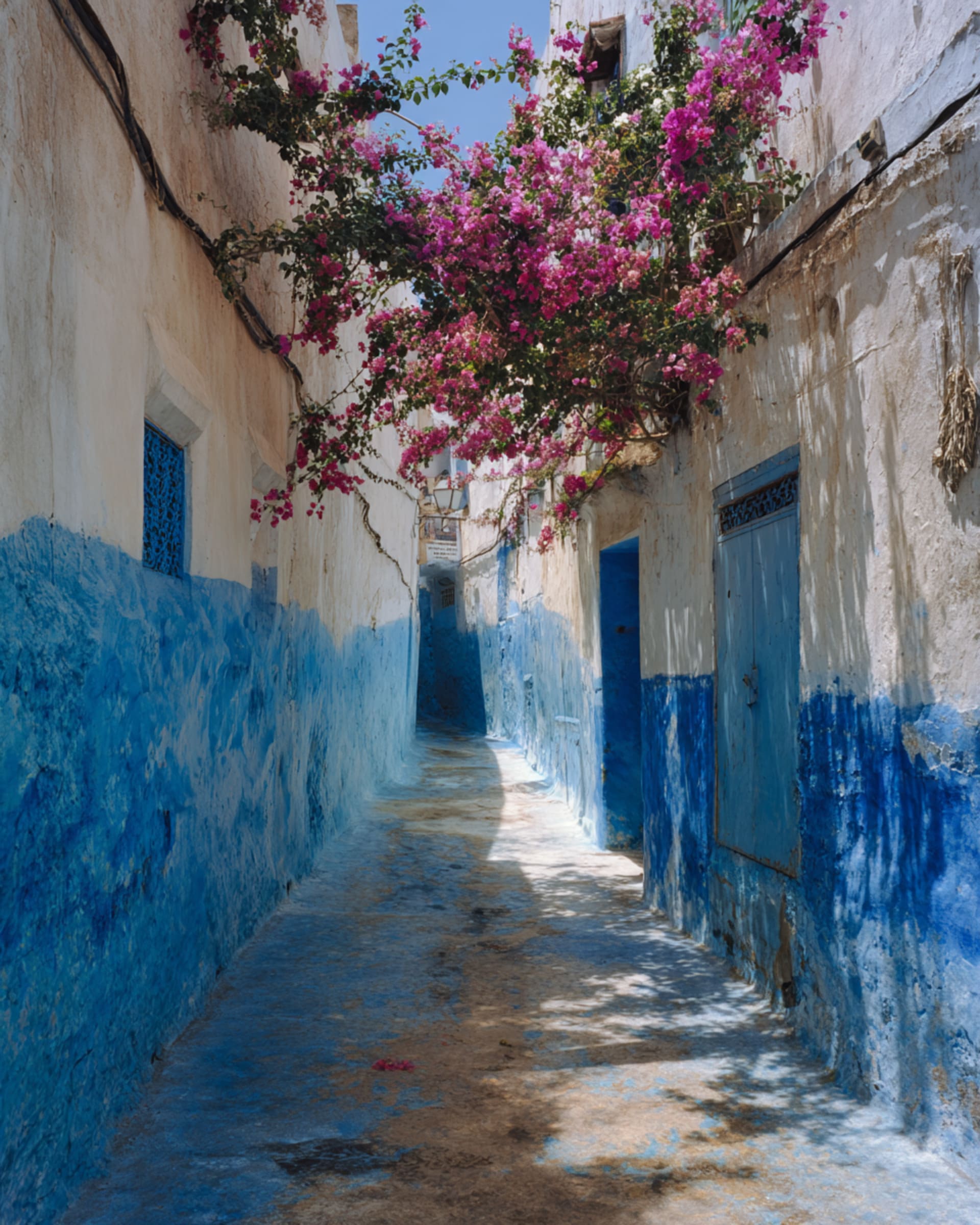
The Kasbah of the Udayas is a twelfth-century fortress at the mouth of the Bou Regreg, its gates some of the finest Almohad architecture in existence. Inside the walls, an Andalusian garden — formal, geometric, planted with citrus and roses — was laid out in the seventeenth century for Moorish refugees expelled from Spain. The quarter around the garden is painted blue and white in a tradition shared with Essaouira and Chefchaouen, the connection between them being the Andalusian communities who arrived with their colour preferences intact.
Chellah, fifteen minutes walk from the medina, is where Rabat becomes strange and specific. The Romans built a town here called Sala Colonia in the first century BCE. After the Romans left, the Merenid sultans of the thirteenth century built a necropolis over the ruins — graves of sultans and scholars inside Roman walls, with minarets rising from Roman foundations. Storks nest on every tower. In spring the storks arrive in February and the noise and mess they create is considerable and entirely indifferent to the architecture.
The Mohammed VI Museum of Modern and Contemporary Art, opened in 2014, holds the most significant collection of Moroccan modern art in the world and is visited by a fraction of the people who stand in line for the Bahia Palace in Marrakech. The collection runs from the early twentieth century to the present and is strong on the École des Beaux-Arts de Casablanca — a generation of painters who worked at the intersection of Amazigh abstraction and European modernism in the 1960s and 1970s.
Rabat works as a day trip from Casablanca — forty minutes by train, trains running every hour — but it rewards an overnight stay. The restaurants in Agdal and Hassan neighbourhoods are good, the prices are lower than Marrakech, and the medina is calm enough to walk without purpose.
Places
Neighborhoods
Rabat's original fortress, turned home by Andalusian refugees after 1609. Blue and white streets, flower pots on steps, cats in doorways — the palette came before Chefchaouen.
Monuments
An unfinished minaret from an unfinished mosque. The Almohad sultan died before completing what would have been the world's largest mosque; the 1755 earthquake finished the ruin.
Monuments
Romans built a city here; Muslims built a necropolis on top. Now nature builds something else — storks nesting on minarets, fig trees cracking walls, spring wildflowers over graves.
Museums
Morocco's major art museum, opened 2014. Orientalist paintings (the European view) alongside contemporary Moroccan artists (the corrective). The white curves of the building make their own statement.
Nature
Inside the Kasbah of the Udayas, a formal Andalusian garden built in the early 20th century on the site of a 17th-century Andalusian settlement. Orange trees, roses, and a central fountain — the same design vocabulary as the gardens the exiles left behind in Córdoba. The ocean is visible over the kasbah walls from the garden terrace.
Architecture
The Makhzen — the royal palace complex of Rabat — occupies a vast walled enclosure in the centre of the city. The ceremonial gates are visible from the Avenue Mohammed V. The complex is not open to visitors, but its presence shapes everything around it: the wide ceremonial boulevards, the police cordons, the silence that falls over this part of the city at certain hours.
Museum
The National Museum of Jewellery in Rabat, housed in a 19th-century palace in the medina. Morocco's jewellery tradition — Berber silver, Fassi filigree, Saharan amber — is among the most technically sophisticated in Africa. The collection documents eight centuries of ornament as cultural archive: each region's identity encoded in metal and stone.
Stories from Rabat
Architecture
The sultan wanted the largest mosque in the world. He died before it was finished. The tower stands at exactly half its intended height.

History
Four cities. Four dynasties. Four reasons. Each imperial capital still carries the architectural DNA of the rulers who built it.
Craft
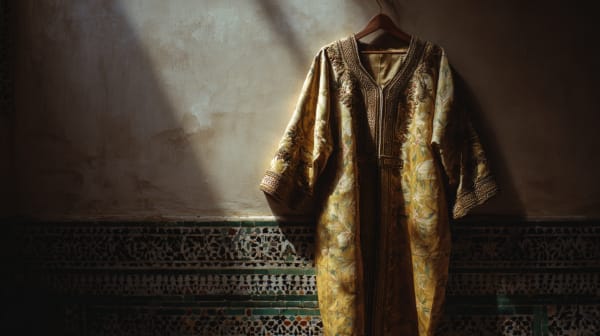
Moroccan fashion is not costume. It is a living system — worn daily, adapted seasonally, and governed by social codes as precise as any European dress protocol.

History
The storks arrived before the tourists and have never left. Chellah sits on the southern edge of Rabat, behind crenellated walls that were built by the Marinids in the 14th century to enclose something much older.

Wildlife
Thirty-three lions pace their enclosures in Rabat. They are descendants of the royal collection — the last bloodline of the Barbary lion, the animal that once terrified Roman legions and inspired the coat of arms of half a dozen nations.

History
Mohammed V is buried beside the tower his Almohad predecessor never finished.
You might also consider
Journeys that pass through Rabat

MACMA, whitewashed galleries, and the young Moroccan artists rewriting their country's visual language — while nobody outside is paying attention yet.

Meknes vineyards to Essaouira oysters — Morocco's terroir hiding in plain sight.

Volubilis, Chellah, Lixus — following Rome's African frontier through ruins most visitors never find.
FIFA World Cup 2030
Morocco will co-host the 2030 FIFA World Cup alongside Spain and Portugal — the first World Cup to span three continents. Six Moroccan cities will host matches, with Rabat among them.
Stadium
Stade Prince Moulay Abdellah
Capacity
68,700
Status
Completed — inaugurated September 2025
A new-build sports complex completed in record time between 2023 and 2025. Inaugurated during the 2026 FIFA World Cup qualifiers. The 68,095-seat venue is expandable to 68,700.
Morocco is investing over $1.4 billion across its six World Cup venues. The high-speed rail network — already connecting Tangier to Casablanca — is planned to extend south to Marrakech and Agadir before 2030.
Interactive stadium & infrastructure map →Plan your visit
Every journey we design includes private guiding, accommodation chosen for character rather than category, and the kind of access that takes years in Morocco to arrange.
Plan Your TripWritten from the medina. Sent when it matters.