Architecture
The Door You Would Walk Past
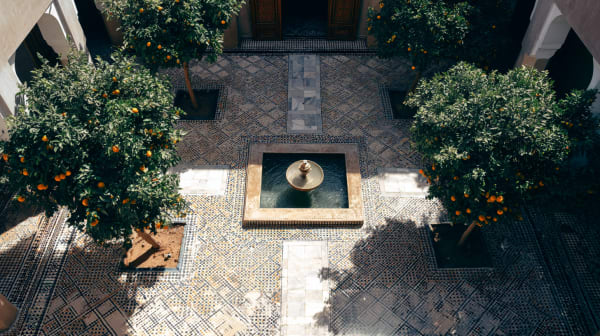
The door in the wall is plain. Ordinary. You would walk past it without looking. Then it opens, and you fall into a garden surrounded by sky.
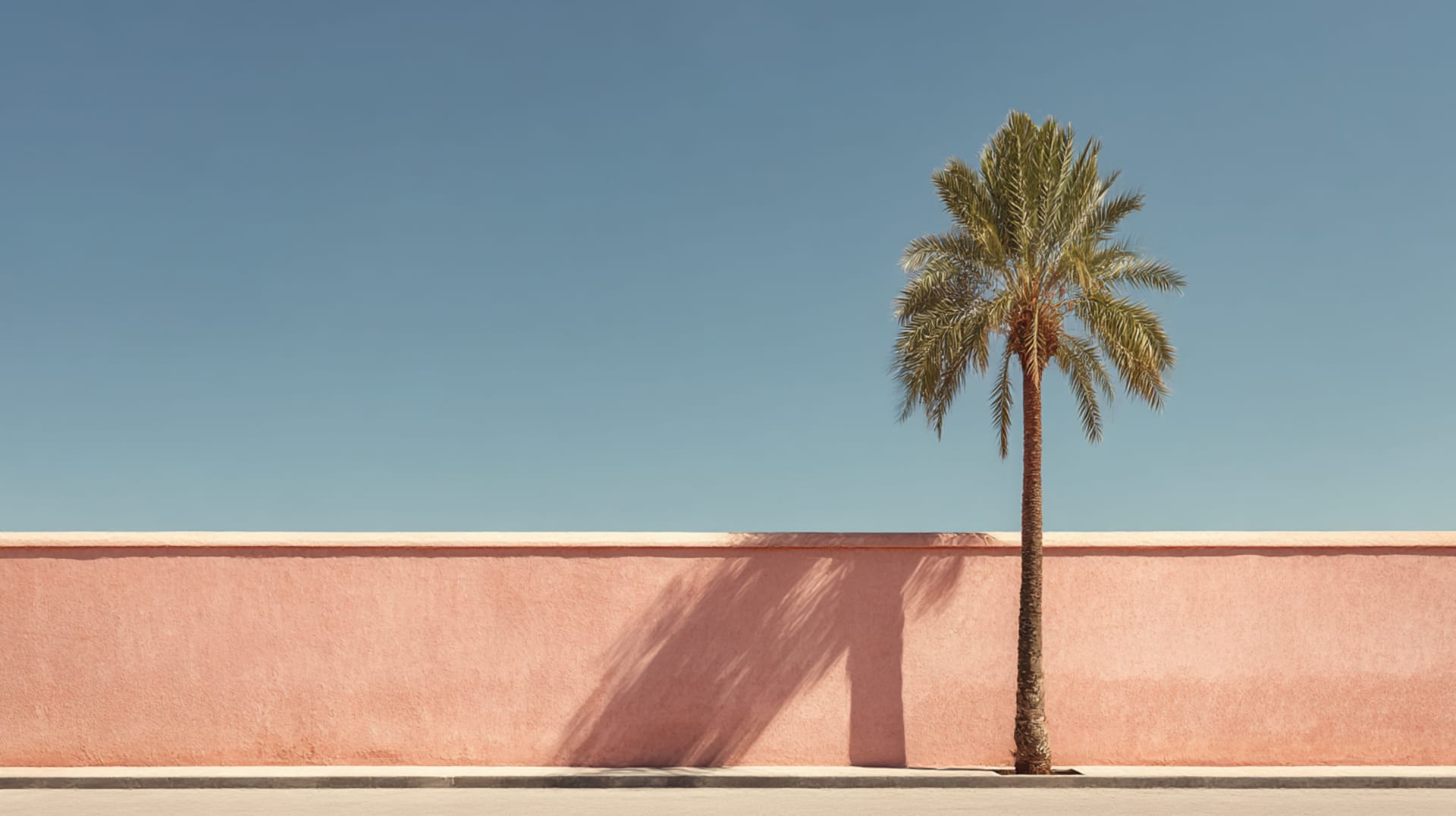
The ochre comes from the soil. When the Almoravids built the first walls in 1062, they used the earth beneath their feet — iron oxide red, baked by a sun that reaches 42°C in July. Every wall built since has matched it. The colour is not a choice. It is a geological fact.
The medina is nine centuries old and still functions as a city. Not a museum of a city, not a reconstruction — an actual place where 300,000 people live, work, worship, and sleep. The confusion most visitors feel is not disorientation. It is the correct response to encountering a logic that was never designed for them.
Jemaa el-Fna, the main square, has been a gathering point since the eleventh century. UNESCO designated its traditions — the storytellers, the water sellers, the Gnawa musicians — as Intangible Cultural Heritage in 2001, the first time the designation was applied to a living space rather than an object. There are now fewer than five traditional storytellers left who perform in classical Arabic. The snake charmers are still there.
The medina divides into quarters that each city resident knows by name and most visitors never learn. The Mouassine neighbourhood, northwest of Jemaa el-Fna, holds the finest private architecture in the city — riads built by merchant families in the sixteenth and seventeenth centuries, many of them now hotels. The mellah, the former Jewish quarter east of the royal palace, is older and less visited. It was established in 1558 and held the largest Jewish population in the Arab world until the mid-twentieth century.
Yves Saint Laurent arrived in 1966 for a party and the city never let him go. He and Pierre Bergé bought Dar el-Hanch before leaving. In 1980, they bought the Majorelle garden — a painter's estate gone to ruin — and restored it over a decade. Saint Laurent's ashes were scattered there in 2008. Bill Willis arrived the same year, 1966, stayed forty-three years, and died in Marrakech in 2009. Matisse came in 1912 for three months and left, but wrote to a friend that "the revelation came to me from the Orient." Some cities work on certain people this way.
The best time to visit is March to May and September to November. In June, July, and August the medina heats to a temperature that makes the narrow alleys feel sealed. In December and January the nights drop to 3°C and the mountains behind the city hold snow. The spring shoulder season is the most forgiving: warm days, cold evenings, the orange blossom still in the air.
Gueliz, the French-built new town to the west, is where Marrakech residents actually eat, shop, and live. The restaurants are better, the prices are lower, and nobody will follow you down the street. The taxi from the medina takes eight minutes.
What most visitors skip: the Saadian Tombs, sealed for two centuries and rediscovered in 1917, hold sixty-six members of the Saadian dynasty in a chamber of carved stucco that took craftsmen twelve years to complete. They are one hundred metres from the Bahia Palace and receive a fraction of the footfall. The Mellah market, just outside the old Jewish quarter, runs Tuesday and Sunday mornings and sells produce to the city's residents. No one will try to take you anywhere.
Places
Palaces
A 19th-century palace built by a grand vizier for his four wives — each apartment calibrated to signal rank without causing war. The painted cedar ceilings alone justify the visit.
Gardens
Forty years of a French painter's obsession, saved from developers by Yves Saint Laurent. The cobalt blue is not Moroccan — it's the colour of one man's attempt to capture the sky.
Monuments
Sealed for 300 years by a rival sultan who couldn't destroy them but refused to honour them. Rediscovered by aerial survey in 1917, the craftsmanship rivals the Alhambra.
Museums
Morocco between 1870 and 1950 — Berber chiefs, Jewish merchants, ceremonies now forgotten. The rooftop has mint tea and Atlas views away from the chaos.
Monuments
For 400 years, 900 scholars lived in 130 cells around this courtyard, dedicated to theology and Islamic law. The students are gone; the carved cedar and zellige remain.
Palaces
The Incomparable. A 16th-century Saadian palace built with Portuguese ransom gold -- now an open-air monument where storks nest on the ramparts.
Neighborhoods
The Jewish quarter tells a different Marrakech — balconies permitted here but forbidden elsewhere, streets wider, rhythms quieter. The Miaara cemetery holds tombstones dating back centuries.
Architecture
The only surviving Almoravid structure in Marrakech, built in the 12th century to shelter ablution pools. Its carved cedar ceiling — star patterns inside a dome — is the template from which all subsequent Moroccan decorative geometry derives. Everything that came after began here.
Gardens
Hidden behind an unassuming medina door — a 19th-century palace garden restored after decades of decay. Two gardens: one Islamic, one exotic.
Museums
The Glaoui pasha entertained Churchill and Colette here. Now a museum of confluence — courtyards behind courtyards, carved stucco rising three stories. The coffee museum traces the drink from Ethiopia.
Architecture
The most ornate of Marrakech's nineteen gates, built by the Almohads in the 12th century as the ceremonial entrance to the royal kasbah. The name means "gate of the blacks" in Tamazight — a reference to the sub-Saharan soldiers who once guarded it. The carved limestone has been softening for nine centuries.
Landscape
A stone desert forty minutes from Marrakech. The Atlas Mountains fill the horizon. Luxury camps offer swimming pools, candlelit dinners, and silence — the desert experience without the eight-hour drive south.
Market
The main artery of the Marrakech souk quarter, roofed with a latticed canopy that filters the light into something golden and diffuse. The name comes from the tinsmiths who originally worked here. The tinsmiths are gone. What replaced them is a curated version of the medina — but the architecture and the light are still entirely real.
Museum
Housed in the 19th-century Dar Menebhi palace, around a courtyard with a chandelier the size of a small tree. The collection is secondary. The building is the reason to visit — a Moroccan palace in full operation, with enough rooms that you can always find one with no one else in it.
Museum
Built next to the Jardin Majorelle in 2017 to house the archive and legacy of Yves Saint Laurent, who first visited Marrakech in 1966 and returned every year until his death. The building is a terracotta cube designed by Studio KO. The collection traces the relationship between Moroccan colour, textile, and light and one of the most influential fashion archives of the 20th century.
Nature
A 12th-century agricultural estate on the western edge of the city, centred on a rectangular pool fed by an underground khettara channel from the Atlas Mountains. The pavilion at the water's edge was built by the Saadians in the 16th century. On a clear morning, the Atlas reflects in the pool. The olives are still harvested in November.
Nature
A palm grove of 150,000 trees on the northern edge of Marrakech, planted according to legend by the date stones discarded by the soldiers of a passing army. The Almoravid story is probably myth. The palms are real. The drip irrigation system that sustains them is Roman in origin. The luxury hotels now occupying parts of it are 21st-century.
Culture
A 16th-century riad in the Mouassine quarter that operates as a literary café and cultural space — poetry readings, art exhibitions, concerts in the courtyard. The building itself is exceptional: carved stucco, painted cedar, a courtyard that has hosted 500 years of private life. One of the few places in the medina where the contemporary and the historic are in honest conversation.
Stories from Marrakech
Architecture
The door in the wall is plain. Ordinary. You would walk past it without looking. Then it opens, and you fall into a garden surrounded by sky.

Architecture
Grand Vizier Ba Hmad had a problem: four wives, twenty-four concubines, and the need to keep them all happy — or at least separate. His solution was architectural. The Palais Bahia is eight acres of courtyards, gardens, and apartments designed so that no woman ever had to see another.

Architecture
Ahmad al-Mansur built El Badi to show the Portuguese what they'd lost. Gold, onyx, Irish oak — 360 rooms of excess funded by ransom money. A century later, the Alaouites stripped it bare. What took 25 years to build took 10 years to dismantle. The ruins are the story.

Architecture
The Almohads built the Koutoubia Mosque. Then someone realized the mihrab wasn't aligned with Mecca. Rather than adjust the prayers, they rebuilt the entire mosque. The minaret they raised became the template for towers across three continents.

Architecture
The Ben Youssef Medersa trained scholars for 500 years. 900 students lived in 130 cells the size of closets, memorizing the Quran by candlelight. The architecture was designed to focus the mind: no windows, no distractions, just text and silence.

Design
River stones pressed into wet plaster until the wall sheds water like skin. The technique is a thousand years old. It is dying.
Journeys to Marrakech
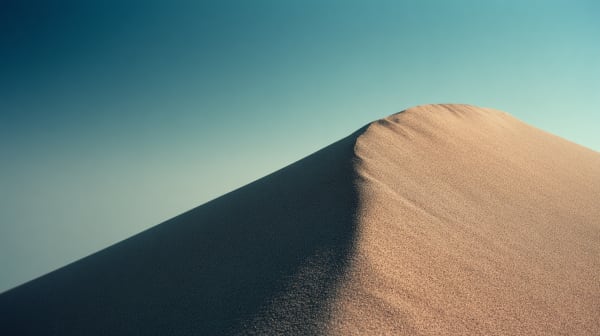
Mountains to sand and back. Stars so dense they press against your chest — and a silence that rewrites what you thought quiet meant.
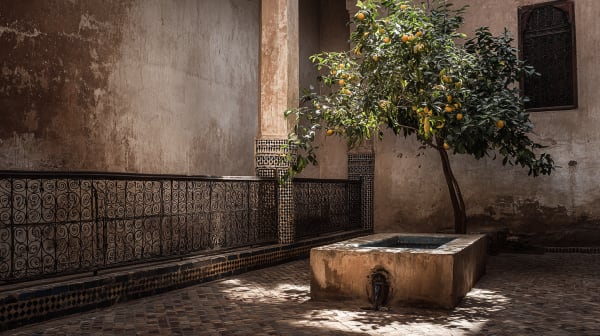
Three days to learn a medina's rhythm — souks at dawn, hidden gardens at noon, the square becoming a theatre at dusk.
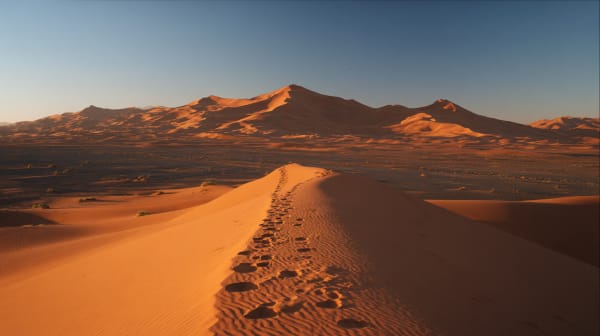
The classic — red city to medieval labyrinth via the Sahara. The corridor that defines Moroccan travel.

Descent through ancient rhythms. Return through gorges where the stone remembers everything — and your phone camera remembers nothing accurately.

Wind, grilled fish, Atlantic light — four days where the sea rewrites your clock and nobody asks you to hurry.

Morocco's deepest canyon — three hundred metres of vertical limestone with barely enough room for the river and your held breath.
You might also consider
Journeys that pass through Marrakech

The classic desert crossing — medieval labyrinth to red city, with the Sahara in between.
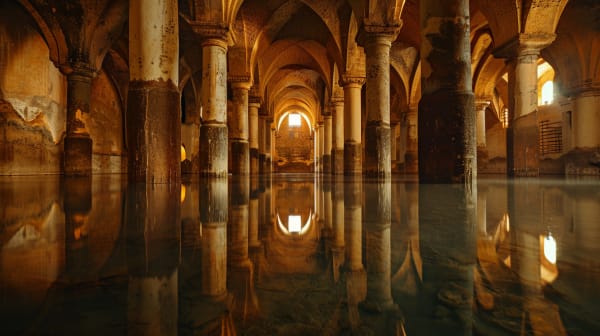
El Jadida, Mazagan, and the fortresses Portugal left in Morocco's stone — the empire sailed away but the architecture refused to follow.

MACMA, whitewashed galleries, and the young Moroccan artists rewriting their country's visual language — while nobody outside is paying attention yet.
FIFA World Cup 2030
Morocco will co-host the 2030 FIFA World Cup alongside Spain and Portugal — the first World Cup to span three continents. Six Moroccan cities will host matches, with Marrakech among them.
Stadium
Grand Stade de Marrakech
Capacity
70,000
Status
Renovation planned
Currently 45,000 seats, set to expand to 70,000 for the World Cup. Located on the outskirts of the city, the stadium also hosted matches during the 2025 Africa Cup of Nations.
Morocco is investing over $1.4 billion across its six World Cup venues. The high-speed rail network — already connecting Tangier to Casablanca — is planned to extend south to Marrakech and Agadir before 2030.
Interactive stadium & infrastructure map →Plan your visit
Every journey we design includes private guiding, accommodation chosen for character rather than category, and the kind of access that takes years in Morocco to arrange.
Plan Your TripWritten from the medina. Sent when it matters.